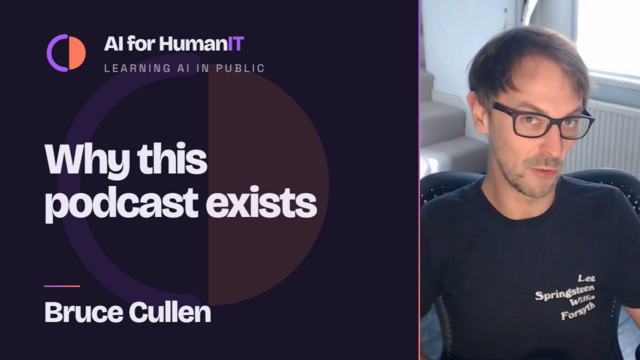
If you're looking for an AI expert with all the answers, this probably isn't the show for you. I said that at the top of the first episode and I meant it. I'm a product person. I've spent the last couple of years experimenting with AI, and some of it has been brilliant while some of it has been completely useless.
So why start a podcast? Because I think we're on the edge of something that will change how we work, and not just in tech or IT. I'm seeing the effects in my own industry and in others too. I'd rather work through that out loud, with other people, than pretend I've got it figured out. The first episode had no guest and no script. It was just me explaining where I've come from and why I'm doing this.
Where I'm coming from
I started in first and second line IT support in 2003. That meant Windows XP rollouts, paper jams, SQL database upgrades and a whole data centre sitting in a physical rack in an air-conditioned cupboard. I did that for about 18 months before university.
After that I joined Citrix as a software tester, first as an intern and then as a graduate. I tested for around four years. I couldn't script, let alone code, so automation wasn't really open to me. I moved into project management and ended up running Citrix's flagship virtual apps and desktops products, both on-prem and cloud, which meant I watched that shift happen from the inside.
Then came startups. I joined Squared Up when it had around 25 people, and it was the first time I saw the full range of skills a business actually needs. In 2019 I spun out Cookdown with Nathan. That's where I became a product manager: working out what customers want, prioritising, getting things built and presenting the results. All of that was before AI came along.
How my use of AI changed
My first attempts were what I'd call level one: type a prompt, get a response. I used it for demos, blog posts and a bit of social media. It wasn't bad for scripts. The blogs worked, sort of, but they sounded very generic.
The low point was a conference speaker bio. I gave it my CV and my LinkedIn profile, and it got my name right and mangled all my credentials. It was a useful early lesson in hallucination.
In 2023 I started using it for image generation at work. In those days everything came out looking like a bad cartoon. I also played with music generation, mostly for fun. It was a good way to see what else was possible.
Last year was when things really changed. I started using AI to design and to build software. As a tester I couldn't automate anything. Now I can, in air quotes, code full applications. I'm not really doing the coding, of course. But it's shown me what's possible, and it raises a fair question: if AI can generate reasonable code, what does that mean for the people who wrote it before?
From paint frames to interactive mocks
This is the change that has mattered most to me as a product person. At Cookdown, my first wireframes were made in Microsoft Paint. We called them paint frames: annotated screenshots with scribbles on them, glued together in PowerPoint to show a flow. That was only 2019.
Later I moved to Figma and worked with real designers. I'd sketch something and send it over, and it would take them a few days to a week to come back. Then we'd go back and forth. Even after all that, the result was usually about the UI rather than the UX.
Now I generate fully interactive HTML mocks. The speed is the obvious gain, but for me the real benefit is that I can concentrate on flow. I almost don't care what the UI looks like, as long as it works and looks decent. If a product is intuitive, people will figure out how to reach the good bits. I've also been looking at how to measure what people actually do: which features they use, how they get to them, and which buttons they click that don't do anything.
Personal software, with a human deciding
Today a lot of my working day runs on things I've built with AI, from a daily to-do list to a tool I was building the morning we recorded. That tool helps me find events we might sponsor as a company. It has two parts. The first is research: which events are out there and which ones fit. The second is me deciding. This one's worth a look. This one doesn't fit. This one might work next year, but it's a bit expensive.
That split matters to me. The AI does the legwork and a human makes the call.
I also use it in my day job for product mocks, bug fixes and small features. Only small ones, though. I wouldn't advise product people like me to build everything, because that's how you end up in vibe coding pickles.
The product I work on at WorkspaceDNA, who sponsor the show, is ATP360. It turns a document, a prompt or a video into a structured test case with steps and defined pass and fail criteria. It then runs those tests using computer-using agents. So how good those agents are, and how we improve the models with data from the product, is very much on my mind right now.
Even this podcast is built this way. The intro was made with Claude design, and the music was generated. I built the admin portal behind the website, which handles uploads, posting and episode descriptions, with AI in about a week at most. I don't post straight AI content often, though, because it doesn't sound like me. I'm still working that out.
What comes next
My first guest is Nathan, my Cookdown co-founder. He's now a senior software engineer, and he's the person who got me using AI as a builder rather than just for blogs and scripts. We'll talk about what's changed over the past year and where he thinks it's going.
After that I want to run round tables that are open to anyone, like joining a Teams call. Everyone adopting AI has different politics, governance rules and levels of understanding. I want to hear about the real lessons and mistakes, not just the headlines.
My main takeaway from putting this episode together is that iteration beats trying to get everything from one perfect prompt. If you work in IT, my suggestion is to pick one small, annoying task and build yourself a tool for it. Keep the decisions with you, and stay honest about where the tool falls short.
You can listen to the full episode on Spotify. If there's someone you think I should talk to, find me on LinkedIn.
 Listen to the episode on Spotify